header.php

At the Ready: Action Pistol Shooting Must-Have Accessories
By Lanny Oakley
Action shooting is one of the fastest-growing segments of the shooting sports. From United States Practical Shooting Association (USPSA) and Steel Challenge pistol matches to dynamic 2-Gun and 3-Gun competitions, these events combine speed, accuracy and problem-solving under pressure.
While skill, practice and mental discipline are the foundation of success, the right gear can make a meaningful difference. Proper accessories help shooters move efficiently through stages, manage equipment under time pressure and maintain consistency from one stage or match to the next.
Here are some of the most important accessories every competitive pistol shooter should consider — whether it’s preparing for your first match or refining your setup for higher-level competition — regardless of shooting division.
1. A Purpose-Built Competition Belt System
One of the first upgrades many competitors make is a dedicated competition belt system. Most competitive shooters use a two-piece belt setup consisting of an inner belt worn through the belt loops and a rigid outer belt that attaches via Velcro.
This system keeps gear firmly in place, while allowing you to quickly remove the outer belt between stages — especially if you have to run to the restroom. A quality competition belt provides these things:
- Rigidity to support magazines and holsters
- Stability when running or changing positions
- Consistent placement of gear for fast access
Consistency is critical in competition. When your equipment stays exactly where you expect it, reloads become smoother and more repeatable. Hogue Inc. and Safariland make great belts for competition shooting.
2. A Reliable Competition Holster
A good holster is essential for both safety and performance. For USPSA, 2-Gun and 3-Gun competitions, shooters typically choose a Kydex competition holster that provides the following benefits:
- Solid retention (i.e, your firearm won’t fall out when moving or running)
- Fast, unobstructed draws
- Adjustable ride height and cant
- Completely covers the trigger guard
- Durable construction
Many competition holsters are designed with open or minimal front profiles to allow the muzzle to clear quickly during the draw. The key is finding a holster that balances speed with secure retention, particularly during movement. It’s not fun going home with a disqualification, which is what would happen if your firearm were to fall out onto the ground — so take time to find a good holster.
Before competing, always ensure your holster complies with the rules of the division you’re shooting in, as equipment regulations can vary.
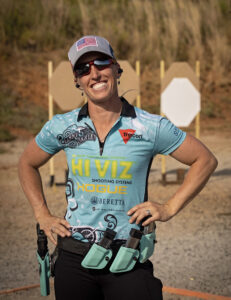
Lanny showcases her preferred holster setup with pistol and extra magazines securely in place.
3. Magazine Pouches for Fast Reloads
In dynamic shooting sports, reloads happen under pressure and often while moving. Having the right magazine pouch setup can significantly improve efficiency.
Competition magazine pouches typically include these features:
- Adjustable retention
- Forward-facing magazine orientation
- Rigid construction for easy indexing
- Ability to adjust orientation for quicker reloads
Most shooters carry three to five spare magazines, depending on the match format and stage design. Proper placement on the belt allows shooters to build muscle memory, maintain consistent reloads and reduce unnecessary hand movement. Many experienced competitors spend time experimenting with pouch placement and angle until they find the most natural reload position.
4. Extended Magazine Base Pads
Another common upgrade in competitive pistol shooting is extended magazine base pads. These accessories increase magazine capacity within division rules and offer several benefits:
- More rounds per magazine
- Easier magazine extraction from pouches
- Faster seating during reloads
- Improved grip when stripping magazines
In sports like USPSA and 3-Gun, minimizing reloads during a stage can save valuable time. Even when reloads are required, extended base pads make them more reliable and efficient.
5. Reflex Optics and Sight Systems
Reflex Optics have become increasingly common in competitive shooting. Many divisions now allow red dot optics, which can provide several advantages:
- Faster target acquisition
- Improved accuracy at distance
- Better performance on small steel targets
- Easier visual tracking during recoil
While iron sights remain popular in certain divisions, red dot optics have become the standard in many modern competition categories. Regardless of the sight system used, competitors should focus on reliability and durability.
Competition environments involve movement, barricades, dust and high round counts. Gear must withstand the demands of match conditions. One red dot I highly recommend with a big window for faster target acquisition and great durability is the Trijicon SRO.
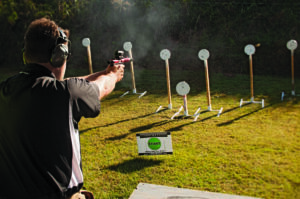
Red dot sights have exploded in popularity over the years, leading to many competitors switching from iron sights.
6. A Shot Timer for Training
While not worn on your belt, a shot timer is one of the most valuable accessories a competitive shooter can own. A shot timer provides objective feedback by measuring the following actions:
- Draw speed
- Split times between shots
- Reload speed
- Overall stage time
Using a timer during practice helps shooters develop efficiency and identify areas for improvement. Many experienced competitors structure their training around time-based drills, allowing them to gradually build speed while maintaining accuracy. One of my favorites is the PACT Club Timer III.
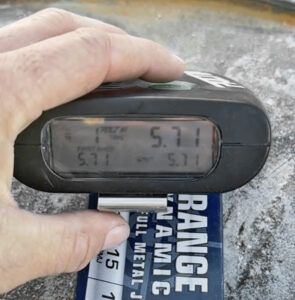
PACT Club Timer III
7. Magazine Loaders
During a full day of competition, shooters may load magazines dozens (or even hundreds) of times. A magazine loader is a small accessory that can make a big difference for the following reasons:
- Reduces hand fatigue or getting blisters
- Speeds up reload preparation
- Allows shooters to stay focused on the match
While simple, this tool can save energy during long match days when competitors are managing multiple stages and high round counts. The best one that I have found is the UpLULA, but definitely put your name on it because it is the product with the fastest-growing legs in the shooting sports.
8. Eye/Ear Protection
Safety equipment is mandatory at any shooting match. Competitive shooters typically choose wraparound ballistic eye protection that offers a clear field of view and wraparound protection, impact protection and anti-fog performance.
Electronic hearing protection is also popular because it allows shooters to hear range commands clearly, communicate with other competitors and maintain awareness of their environment.
Comfort becomes particularly important during full-day matches that can last several hours. Oakley Standard Issue has a lot of great ballistic lens options that look great, too. Grizzly Ears offers great inner ear hearing protection that also has Bluetooth capability. Bluetooth connectivity enables you to listen to music while you practice or get hearing enhancement to be able to hear range commands, while blocking out the shot.
9. A Range Bag Designed for Competition
Competitive shooters carry a significant amount of gear to the range. A well-designed competition range bag helps organize these essentials:
- Ammunition
- Spare magazines
- Tools and maintenance supplies
- Eye/ear protection
- Snacks and hydration
- Extra clothes for inclement weather
Some competitors also bring a range cart, especially at larger matches where shooters move between multiple bays throughout the day. Being organized helps reduce stress and allows competitors to focus on performance.
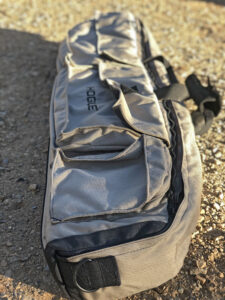
Hogue makes quality range bags for pistols and long guns.
10. Maintenance Tools and Spare Parts
Competitive shooters rely heavily on their equipment, and matches can involve several hundred rounds of ammunition. Many experienced competitors keep a small maintenance kit that includes the following items:
- Multi-tools
- Lubrication
- Spare batteries for optics
- Replacement springs
- Cleaning supplies
- Pocket knife (this comes in handy more often than you think, especially for tasks like removing brass stuck in the chamber under the clock)
Having these items on hand can quickly solve minor equipment issues that might otherwise disrupt a match.
Gear Supports Performance, But Practice Builds Skill
While quality equipment plays an important role in competitive shooting, gear alone does not create results. The most successful competitors focus on developing consistent fundamentals, efficient movement and strong stage planning skills. Don’t forget that the brilliance is in the basics and your foundation can always improve.
Accessories simply support those skills by making equipment more reliable, accessible and efficient.
Competitive shooting offers a welcoming community, an exciting challenge and a rewarding way to develop marksmanship.
With the right preparation — and the right accessories — you’ll be ready to step up to the line when the timer sounds.
Looking for recommendations on how to best accessorize your rimfire pistol for competition? Take a look at this article.
About the Author
Lanny Barnes Oakley is a 3x Olympian (2006, 2010, 2014) in biathlon, a national and world champion competitive shooter, instructor, artist and creator of The Ascent — a platform dedicated to building physical, mental and performance excellence. With over 20 years of experience, she is a lead firearms instructor and co-founder of The Olympian Project, training over 10,000 military, law enforcement and civilian students to perform under stress by mastering the physiological and psychological aspects of shooting.